
Beyond RAG: Building a Unified Context Layer for AI Knowledge Work
Simple vector retrieval is failing complex productivity workflows. Discover why the future of AI knowledge work requires a persistent, unified context layer.
In the early stages of the LLM boom, Retrieval Augmented Generation (RAG) was hailed as the definitive solution to the problem of model hallucinations and static knowledge. The premise was simple: take a user query, turn it into a vector, find similar text chunks in a database, and stuff them into the prompt. It worked for "chat with your PDF," but for professional knowledge work, simple RAG is hitting a ceiling.
Founders, developers, and product managers don't work in isolated PDFs. Their work lives in the connective tissue between a Friday afternoon email, a project roadmap spreadsheet, and a Monday morning calendar invite. When AI lacks access to these relationships, it remains a fancy autocomplete rather than a functional teammate. To move forward, we need to transition from basic retrieval to a unified context layer.
The Limitation of Similarity-Based Retrieval
Standard retrieval augmented generation relies heavily on semantic similarity. If you ask about "Project Phoenix," the system looks for the string "Project Phoenix" across your files. However, semantic similarity is a poor proxy for importance or relevance in a professional setting.
Consider a scenario where you are preparing for a board meeting. The most relevant information might not contain the words "board meeting" at all. It might be a specific pivot in a financial spreadsheet or a nuanced objection raised in a client email thread. Because standard RAG architectures treat data as a flat list of chunks, they lack the structural awareness to understand that an email from a VIP stakeholder should carry more weight than a generic internal memo.
Furthermore, RAG is often ephemeral. The context is gathered for a single turn of conversation and then discarded. In a unified productivity platform, context must be persistent and evolving. It shouldn't just know what you asked; it should know what you are currently working on.
The Unified Context Layer Architecture
An ai knowledge management architecture capable of supporting complex workflows requires more than a vector database. It requires a graph-based understanding of how different entities—people, events, documents, and messages—relate to one another.
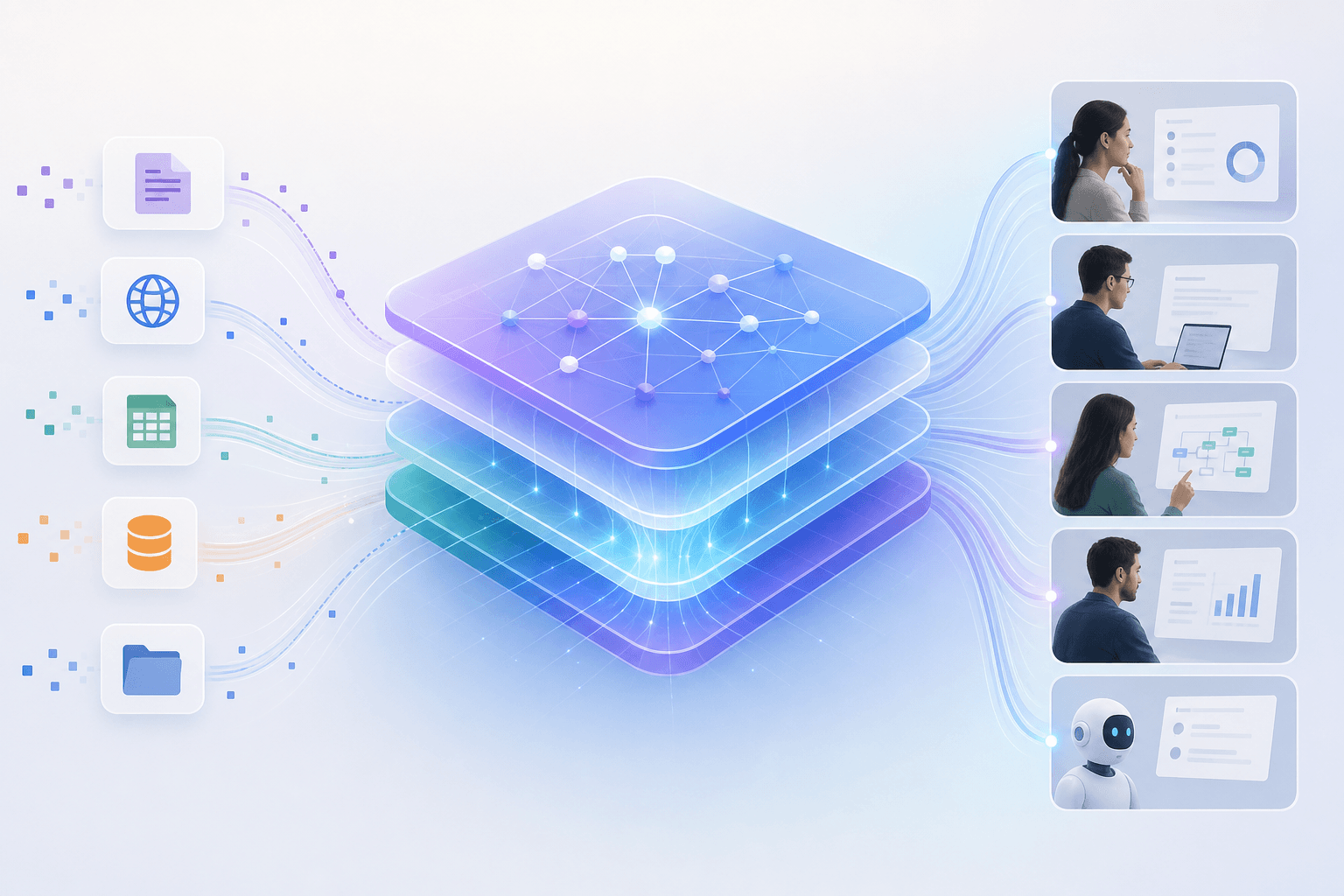
A unified context layer acts as a middleware between your raw data sources and the LLM. Instead of just retrieving text, it retrieves entities and their relationships.
1. Relational Mapping
Instead of indexing "Doc A" and "Email B" separately, the system identifies that "Email B" contains an attachment that was later imported into "Doc A." When you ask a question about the document, the AI automatically understands the provenance and the conversation that led to its creation.
2. Temporal Awareness
In productivity, the when is often as important as the what. A spreadsheet from 2022 is less relevant than a draft from this morning, even if the older one has a higher semantic similarity score. A true context layer incorporates temporal decay and versioning into its retrieval logic.
3. Applied LLM Workflows
Building this layer involves moving beyond simple prompt engineering into applied llm workflows. This involves using smaller, specialized models to pre-process, tag, and summarize data before it ever reaches the primary reasoning engine. This "pre-digestion" ensures that when the main LLM is called, it receives high-signal, structured data rather than a noisy dump of text.
Managing the Context Window
As LLM providers increase context windows to 100k, 200k, or even 1M tokens, there is a temptation to abandon retrieval altogether and simply feed the model everything. This is a mistake for two reasons: cost and cognitive load.
Effective context window management isn't just about fitting more data in; it's about curation. Even models with massive windows suffer from "lost in the middle" phenomena, where they ignore information buried in the center of a long prompt. By using a unified context layer, we can perform "context pruning"—selecting the most high-impact nodes from the knowledge graph to ensure the model stays focused on the task at hand.
// Conceptual schema for a context node
{
  "entity_id": "project_alpha_001",
  "type": "project",
  "related_nodes": [
    { "id": "email_thread_45", "relationship": "origin" },
    { "id": "spreadsheet_v3", "relationship": "financial_source" },
    { "id": "calendar_event_next_tue", "relationship": "deadline" }
  ],
  "last_modified": "2023-10-27T14:00:00Z",
  "priority_score": 0.92
}
Solving the Multi-App Fragmentation
The biggest hurdle to AI productivity is the "app silo." Your email doesn't know what's in your calendar, and your document editor doesn't know what's in your storage. This fragmentation forces the user to act as the manual integrator, copy-pasting text between tabs to give the AI enough context to be useful.
A unified platform solves this by design. When the email client, the spreadsheet, and the calendar share a single underlying data schema, the AI doesn't have to guess. It has a single source of truth. This allows for cross-domain reasoning, such as: "Based on my emails from this morning, update the project timeline in the spreadsheet and invite the relevant stakeholders to a sync."
Security and the Permission Logic
When building an ai knowledge management architecture, security cannot be an afterthought. In a traditional RAG setup, if the indexing process has access to everything, the AI might inadvertently leak sensitive information from a private HR document into a general query answer.
A unified context layer must respect the existing permission structures of the underlying tools. If a user doesn't have access to a specific folder in their storage, the context layer must automatically exclude those nodes from the retrieval graph for that specific user. This requires a granular, identity-aware retrieval system that goes beyond simple API keys.
The Path Forward
We are moving away from a world where AI is a separate tool we visit to perform a task. Instead, AI is becoming the substrate upon which our productivity tools are built.
To reach the next level of utility, we must stop treating RAG as a search problem and start treating it as a context problem. By building a unified context layer that understands the deep relationships between our data points, we can finally create AI agents that don't just respond to our commands, but actually understand our work.